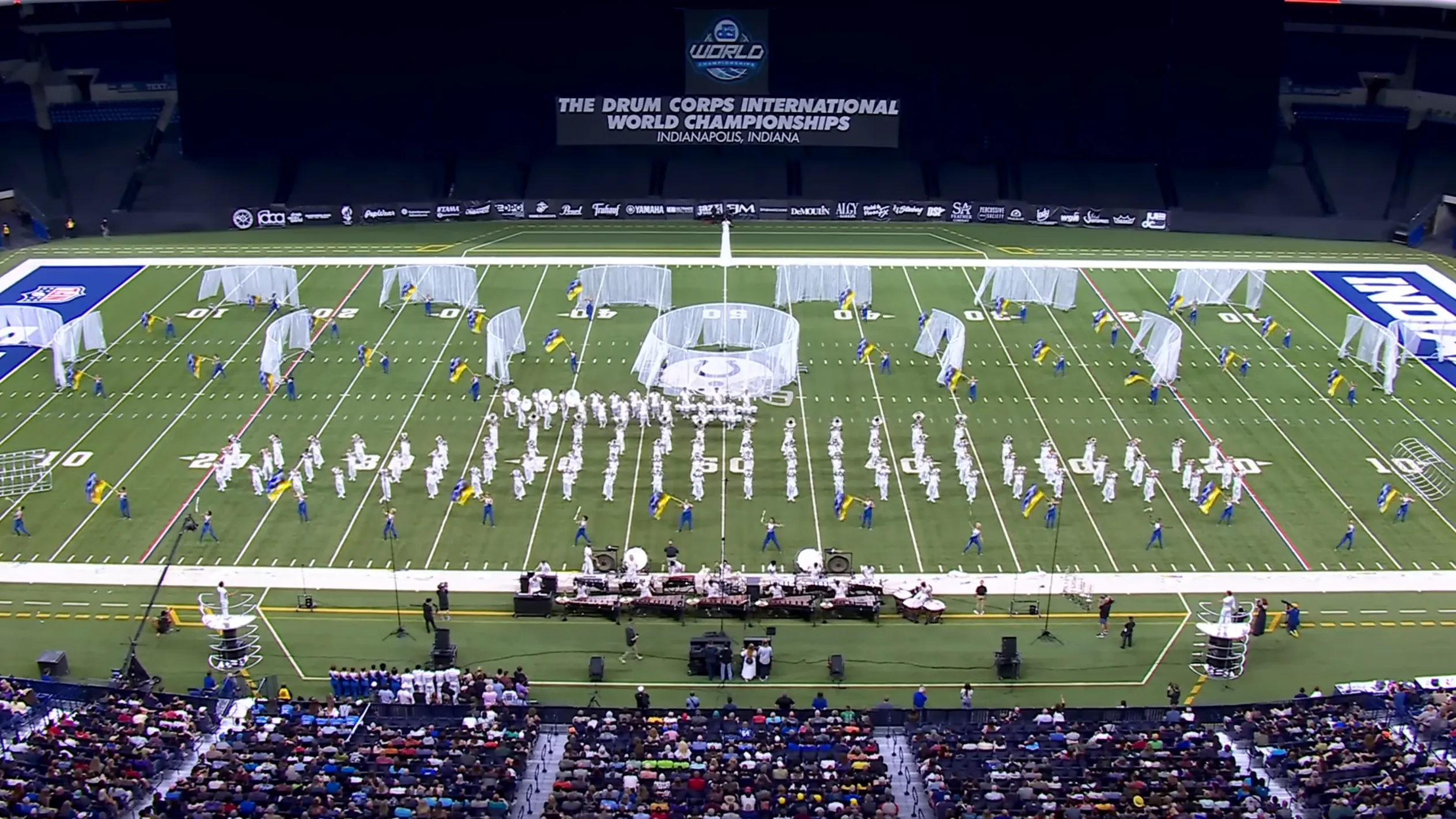
Drill Theory: A look into Phantom Regiment's 2025 production “ “
Mark Shelton
March 5, 2026
Welcome to Drill Theory! A blog series where we break down iconic moments in marching band and drum corps drill design. In this article, we’re taking a closer look at one of Phantom Regiment’s most recognizable drill moments from their 2025 production and analyzing the staging, form development, and visual design techniques used.
This breakdown explores how the drill supports music staging, judging exposure, performer focus, and audience readability. All essential components of effective marching arts drill design.
⚠️ *This analysis is based on observation and interpretation and does not necessarily reflect the original intentions or thought process of the drill writer or design team.*
Who Wrote This Drill?
In this article, we’re taking a closer look at one of Phantom Regiment’s most recognizable drill moments from the modern era. This show was written by Steven Estudillo, one of the top drill designers in the activity and a well-known visual designer in the drum corps and marching band world.
The original drill was created in Pyware 3D, but we’ve transcribed it into OpenMarch so you can explore it yourself!
(You can find a downloadable .dots file at the bottom of this article if you’d like to explore the drill set-by-set.)
Opening Impression of the 5th Movement
Steven wrote this percussion break to end near Side 1 on the 30 yard line, right on the front sideline. That’s not random.
It’s actually a smart staging decision because the percussion judge can fully sample what’s happening without leaving the front sideline. This gives the ensemble an opportunity to maximize judging exposure and clarity during the percussion feature.
At the end of the feature, Steven places the hornline into a coordinated, section-sorted scatter set. This works as a visual reset and clears space on the field so the next idea can build cleanly.
Scatter sets like this are commonly used in drum corps drill design to reset performer spacing while keeping the audience’s attention focused on the next musical idea.
Transition Into the Brass Ensemble Feature

The next idea we move into is a small brass ensemble feature.
Steven keeps those mic’d players close to the center of the scatter, which creates a very smooth transition into the next form.
This is an important concept in drill design theory: staging performers so the audience’s attention naturally flows from one visual idea to the next.
Staging for Judging and Musical Clarity
With the small ensemble positioned fairly close to the front sideline, it creates several advantages.
First, the brass judge can easily sample the performers without leaving the front sideline. Second, it allows the drum set player to lock in with the ensemble more easily.
Since the players are mic’d, they do not need to play extremely loud for the music judges in the press box to hear them clearly. The sound is reinforced through the stadium speakers.
Overall, the staging of the small ensemble allows the ensemble to generate credit both on the field and in the box.
Supporting Motion Behind the Ensemble
During this small ensemble feature, the rest of the hornline performs symmetrical drill while facing backfield.
In the final eight counts, the hornline turns to face the front to represent the end of the musical phrase from the small ensemble.
This moment does two things:
• Visually marks the end of the phrase
• Prepares the hornline to play the next musical entrance
These types of visual phrase endings are a common technique used by drill writers to connect movement and musical structure.

Setting Up the Iconic Mellophone Sustain
Looking back at the scatter set, that moment becomes really important for setting up the next section — the iconic Phantom Regiment mellophone sustain.
As the brass line moves symmetrically, it naturally pulls the audience’s eye toward the center of the field.
You can see the mellophones staged right at the front of the form.
Keeping the mellophones together and placing them up front helps emphasize the impact of the sustain and naturally draws attention to that section.
As this phrase moves into the hold, the form splits the 50-yard line with four-step intervals.
This sets up the next idea where the mellophones split the hornline into two groups and push them away from the 50.

Line Rotations and Symmetrical Motion
In this next visual phrase, Steven writes the hornline into classic rotating line forms that weave in and out of each other.
The idea is mirrored horizontally on both sides of the 50-yard line, which makes the motion very readable for the audience.
This section is particularly effective because there are multiple direction changes and velocity changes, but the symmetry keeps the movement easy to understand.
Design-wise, Steven also keeps the sections grouped in threes, which helps maintain balanced sound projection across the field.
The mellophones initially push their groups away from the 50, but they are also used to pull the groups back together, drawing the audience’s focus back toward the center of the field for the next visual phrase.

Building Toward the Final Circle Form
As the mellophones set up their circle, they create a visual boundary for the trumpets and euphoniums.
Going into the next visual and musical phrase, the two hornline groups break into the circle created by the mellophones. This moment strongly supports what’s happening musically.
Steven keeps the euphoniums and trumpets weaving up and down as they move toward the center of the field, gradually pulling the audience’s focus toward where the phrase ends.
The phrase ultimately resolves in a circle centered on the 50-yard line.
As the ensemble reaches the hold at the end of the chunk, Steven uses the percussion and tubas to create a large curve stretching from the 20 yard line to the 20 yard line around the brass on the 50.
This frames the moment visually and draws even more attention to the hornline and color guard flags.
Explore the Drill Yourself
If you made it this far, I hope you enjoyed this marching band drill analysis and my interpretation of what Steven was trying to achieve with the design.
One of the best ways to understand drill design is to open the file and explore the forms yourself.
Download the transcription below and step through the sets.
📥 Download the Phantom Regiment 2025 Drill Transcription (.dots)
More About Steven Estudillo
If you’d like to see more of Steven Estudillo’s work as a drill writer and visual designer, check out his page below.
Want to learn more about Steven Estudillo’s design process?
Check out these videos where he discusses visual design philosophy and drill writing techniques as well as Steven teaching an ensemble live!
Pastime: Steven Estudillo by Noe Gomez Productions
Factory To Floor (Ch. 5): Mic'd Up Chino Hills Vis Block (Pt. 1) by FloMarching
About the Author (Me)
My name is Mark, and I am a visual educator and drill designer based in Indianapolis, Indiana. I currently work in business development and product research for OpenMarch while completing my undergraduate business degree.
I'm heading into my fifth year of marching Drum Corps International and currently marching baritone with the Carolina Crown Drum & Bugle Corps. I also graduated from Avon High School in 2024, where I was involved in their marching program.
I have worked with marching arts programs throughout Indiana, including:
- Carmel High School
- Plainfield High School
- Fishers Indoor Percussion
If your ensemble is looking for marching band drill design, visual education, or consulting, feel free to reach out.
📧 SheltonVisualDesign@gmail.com
Want to Write Drill?
Interested in creating your own drill?
You can download OpenMarch for free and start designing your own marching band and drum corps productions.