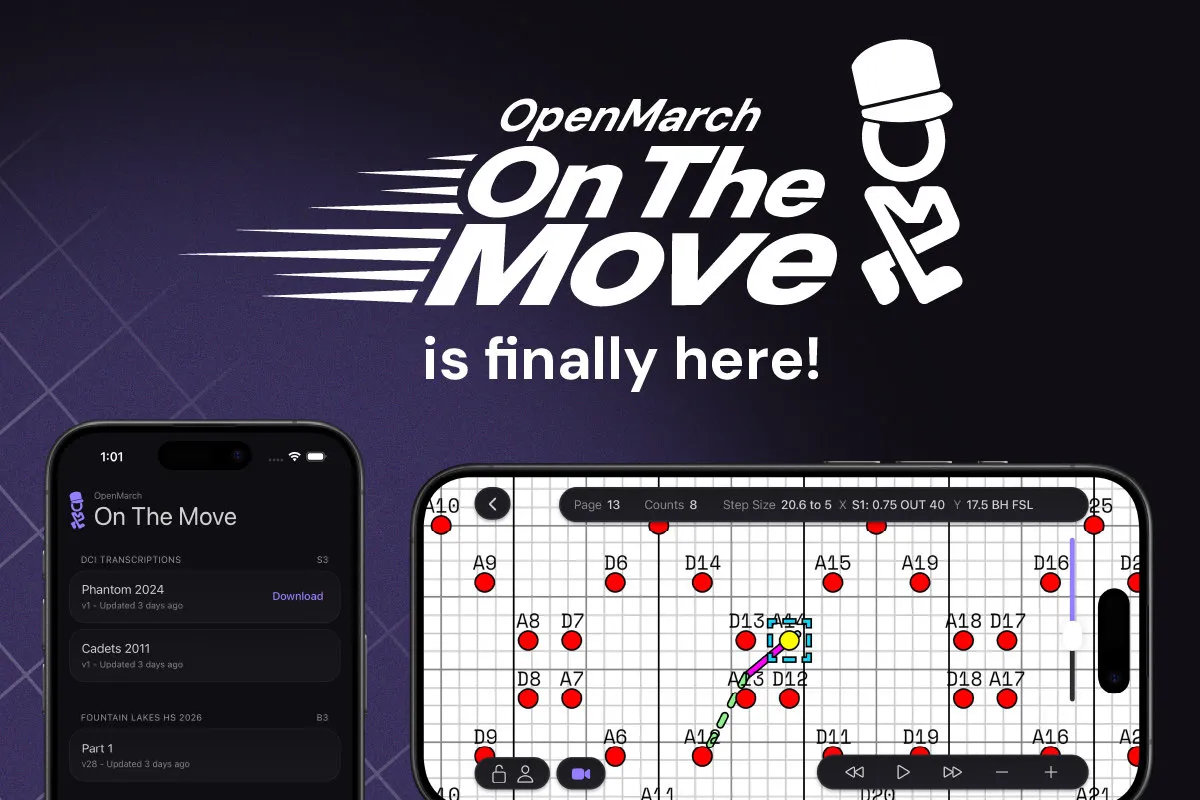
OpenMarch: On The Move, is finally here!
Alex Dumouchelle
June 26, 2026
This project took a monstrous amount of time and coordination from each person on the OpenMarch crew. The team pulled out every stop in their respective disciplines so this mobile app could look clean, comply with student privacy restrictions, market itself professionally, and run with buttery-smooth performance for the ensembles that choose to use it this upcoming season.
While this is something we are super proud to share and release, I know there will likely be a handful of questions:
Wait, it costs money? What happened to free?
This is indeed the elephant in the room, so I won’t waste any time addressing it.
OpenMarch, as an open source project, has been massively successful in its first year. We accomplished many of the goals that we defined in our mission statement by having a user base consisting of 200+ marching bands, 400+ indoor groups, hundreds of hobbyists and aspiring designers, and many music education classes in universities. We have collectively saved the music education space over $250,000 in licensing fees. From many perspectives, this could be considered “mission success.” OpenMarch has done it, they created and distributed a free tool to make drill-writing more accessible, what else needs to be done?
Well, for many who have used the desktop app, it’s just not there in every way. It’s simple, it’s easy, but it’s not feature-complete in many obvious ways. Glaring omissions include follow-the-leader, props, 3d viewing, shape creation, and many performance quirks here and there. “Follow-the-leader” tool has even become somewhat of a meme in the community, and internally. It’s requested constantly. The problem isn’t motivation, it’s time.
When I started OpenMarch fresh out of college, I had a lot of time. Since then, I got married, joined community ensembles, started teaching high school marching band and indoor, and work a full time job. This means that late nights drilling out bugs or implementing features cost a lot more than they used to. This project has burned me out many times, but I keep coming back to it because the community and the team that helps me build it believe in the goal so much: a modern, and free, drill-writing tool.
Getting OpenMarch from "passion project" to "robust tool" is going to take sustained, professional effort. The mobile app is our honest attempt to fund that.
Why a mobile app? Couldn’t you have added more features to the desktop app first?
While follow-the-leader, props, and other features have been heavily requested online, when we talk face-to-face with band directors and educators, we get the same question 90% of the time: “Do you have a mobile app?”
Learning with a mobile device has become very common in the past decade. Printing out paper is annoying, you can watch the animation with the music, and stepping through count-by-count has proven immensely valuable when cleaning drill.
Many directors outright refused to ever consider OpenMarch if there was no sort of mobile offering. It was clear to us that making a clean and simple mobile experience for the on-field staff and performers was essential for OpenMarch to gain more traction.
To be direct, our biggest goal with the mobile app is to give exactly what you need with no fluff. Our thinking was if we could get a first iteration of the mobile app out for ensembles to use, we would know exactly where the line between “essential feature” and “unnecessary bloat” lies. Our main development focus will still be with the desktop app, that is our flagship tool.
But still, why are you charging for this?
Put honestly, building this right costs real money, and running it will too.
We talked to ed-tech law firms to ensure our app complies with student privacy laws. We set up secure cloud infrastructure with recurring backups and storage for your shows. We created phone numbers so directors have a person they can call if something goes wrong. None of this is free, and none of it should be cut.
To be direct, the mobile app is a premium product. If a program doesn't want it, they don't have to use it. The desktop app is not going anywhere and you can still print out drill charts for free.
It’s well-established that almost every "free" service on the internet is free because someone is paying for it. Mostly in the form of ads, data, or investor money. We're not doing any of that. Charging for OTM is our attempt to be upfront about what it actually costs to run something like this responsibly.
The desktop app can stay free because it costs almost nothing to run. There’s no servers, no internet connectivity requirement, releases are published for free on GitHub, and our website hosting is dirt-cheap. The math works for that. A polished mobile app is a different story.
What are you going to do with the money?
Many things! Every dollar will go back either into OpenMarch or the marching arts community. Here’s a few things:
- Pay our team a fair professional rate for the work they do.
- This project runs on volunteers right now, and that's not sustainable forever.
- The people who have contributed their time and expertise to OpenMarch deserve to be compensated eventually.
- Invest in the desktop app. Follow-the-leader isn't going to build itself.
- Attend and exhibit at conferences.
- We’ve been to around five conferences so far as an exhibitor and presenter.
- These massively help us understand what the community is looking for and lets us collect live feedback.
- Cover the costs of student privacy compliance so we can actually serve the schools and ensembles who need this most.
- Sponsor students to attend clinics and, eventually, to march DCI.
- The marching arts gave a lot of us our start. We'd like to give that back.
Why is it not open source?
Many of the most successful open source projects have a closed-source commercial product alongside them. It's not a contradiction, it's usually what makes the open source part sustainable.
It’s fair to think “I thought the whole mission was to make drill design more accessible?” Yes, this is true. But, being 100% honest, a basic mobile app is not hard to build. Anyone could come up with a drill viewing app in a weekend. In fact, we’ve seen about half a dozen of them pop up in our Discord. I personally think these are super cool, because they’re often student developers making something specifically for their program. But, this doesn’t mean that this is what most band programs will want to use.
The app itself isn’t the hard part. It’s the integration with a desktop app, the compliance of school IT systems, student privacy concerns, support when there are issues, and the peace-of-mind knowing that when you launch the app on band camp, you won’t waste an hour of rehearsal trying to get the thing to work.
With that said, I don't want to undersell what this team built. Dhruva, a CS student at UMD, spent months obsessing over the rendering and interaction so the app feels butter-smooth and doesn't kill your battery. This kind of polish doesn’t come from a weekend project.
The desktop app remains AGPL-licensed and open source. That won’t change. OpenMarch: On The Move is the commercial product that funds the continued existence of the free one.
What does this mean for the future of OpenMarch Desktop?
It means we will keep chugging along! We hope that the mobile app makes the desktop app a more appealing option to a wide array of ensembles.
The hope is that OTM gives the desktop app the runway to stop being a “when I have the time” project and start being something that we can commit serious, professional, work to. Follow-the-leader, props, better shapes, we haven’t forgotten them, they’re just waiting on the time to be done correctly.
Get started today
To check out OpenMarch: On The Move, check out the links below!
The desktop app is, and always will be, the mission. The mobile app is how we protect it. We’re incredibly proud of what we’ve built. We hope you like it!